

In 1968, a British politician named Enoch Powell stood before a Conservative association meeting in Birmingham and delivered the most infamous speech in post-war British politics.
He warned of rivers “foaming with much blood” if immigration continued. He quoted a constituent who claimed that “in fifteen or twenty years’ time, the black man will have the whip hand over the white man.”1
Powell was sacked from the shadow cabinet within forty-eight hours. His political career never recovered. For decades afterwards, his name served as a one-word rebuttal to anyone who questioned immigration policy. Don’t be a Powell was the unspoken rule of respectable politics.
For decades, it held.
The rivers of blood, however, never flowed. But the politics Powell represented did.
Fifty-eight years later, the politics Powell represented has moved from the margins into government across much of the developed world. Italy elected a prime minister who campaigns on blocking migrant boats. Denmark’s Social Democrats — the left, not the right — now run on restricting asylum. Britain voted to leave the European Union largely over freedom of movement. In Germany, the AfD draws crowds that would have been unthinkable a generation ago.
Now I want to suggest something uncomfortable.
This current anti-immigration sentiment across industrial nations is understandable. It emerges from legitimate fears.2 But it’s also arriving just as the ground beneath it begins to shift. The countries now trying to restrict immigration are the same countries that will soon need migrants most. Today’s restrictionists may be right about the pressures immigration creates. They may simply be late to the next problem.
Let’s start with the fears, because they’re real.
When a Frenchman worries about immigration changing his country, he isn’t necessarily suffering from irrational bigotry. He’s noticing something true. Immigration does change countries. That’s the point.
But is the change welcome? That’s the bigger question. More importantly, it’s a political question, not a moral diagnosis.
If you dig a little deeper, beneath the catchy slogans, beneath the cultural anxiety, there lies something more primal. Resource competition. It’s true housing costs have exploded across the developed world. It’s true wages for working-class jobs have stagnated. It’s also true public services strain under higher demand. When a British pensioner waits three weeks for a GP appointment, telling her that immigration boosts GDP, or that there are profound systemic factors at play in housing costs, doesn’t address her lived experience. She’s not calculating macroeconomic aggregates. She’s competing for a scarce appointment.
These fears then compound into something deeper: the sense of losing control.
Borders are the most basic assertion of sovereignty — the line where we decide who enters and who doesn’t. When that line feels porous, when decisions seem to happen elsewhere, when the composition of your neighbourhood changes faster than you can adjust, the psychological experience is one of dispossession. Not necessarily accurate. But not irrational either.
The populist right understood this before the technocratic centre did. They offered a simple story: your leaders gave away your country without asking you. The story was partially true.
Here’s what the restrictionists haven’t reckoned with, though: demography doesn’t negotiate.
The industrial world is shrinking — not metaphorically. Literally. South Korea’s fertility rate has fallen to 0.80, far below the 2.1 replacement levell. Japan’s population peaked in 2010 and has declined every year since. Deaths have exceeded births in Germany since 1972, and the UK is projected to follow from 2026. By 2030, on the Congressional Budget Office’s own projection, the United States will join the list. Spain, Portugal, Greece, Hungary, Russia, Thailand, Taiwan, and China are already there.
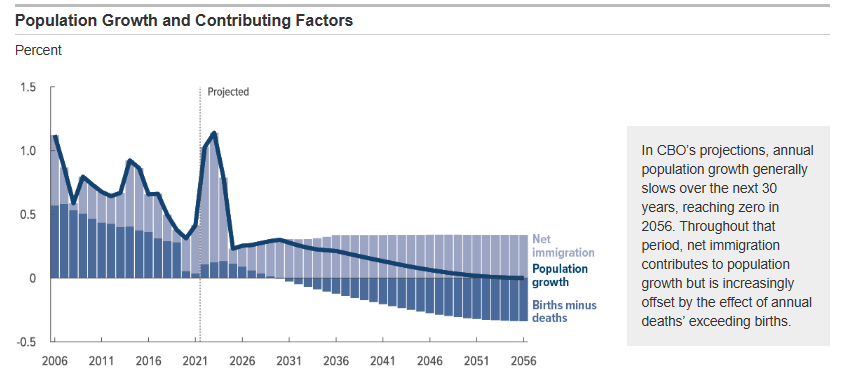
These are today’s numbers, already baked into tomorrow’s workforce.
A wave that began in 2011 is nearing its end. Baby boomers are leaving the workforce en masse. Here in Australia, industry estimates suggest they will be largely gone from workplaces by 2028 or 2029.3 The exact date matters less than the direction. The largest post-war generation is moving from production into retirement.
That creates a problem no government can message its way around.
A country can survive an ageing population if it has saved enough to support retirees. Most haven’t. The developed world has instead accumulated debt — promises to pay future pensions and healthcare costs that assume future workers will exist to fund them. America’s Social Security trust fund faces depletion by 2033. France’s pension system nearly triggered revolution in recent years. Japan’s debt-to-GDP ratio exceeds 230 percent, the highest in the developed world.
Fewer workers means a smaller tax base. A smaller tax base means either benefit cuts or higher deficits. Benefit cuts mean political revolt from the elderly, who still form a large voting bloc. Higher deficits mean either inflation, or borrowing costs that crowd out everything else. Inflation means everyone blames the government.4 This is the squeeze.
More care. More health. More maintenance. More public spending.
Fewer workers to provide it.
Yes, automation helps, but it doesn’t solve the problem. You can automate parts of finance, administration, manufacturing, agriculture, logistics, and software. You cannot, however, fully automate a nurse turning a patient, a builder repairing a roof, or a carer helping an eighty-six-year-old shower.
While machines reduce labour in some places, they still need capital, energy, maintenance, regulation, trust, and deployment at scale. They do not become taxpayers. They do not vote. They do not replace judgement, touch, language, trust, or presence.
When you squint long enough, you’ll see that other levers exist. But immigration is the only one that moves fast enough to matter.
Fertility policy, for example, can move the numbers. But only slowly. You’d need to get the settings right on housing, childcare, work culture, gender norms, and family policy. Even then, the gains arrive unevenly and expensively. Most pronatalist policies, in my view, tend to manage symptoms rather than root causes. Take these two countries, for example: Hungary spent five percent of its GDP on family-friendly initiatives. South Korea spent $270bn over two decades. Both have struggled to move the numbers meaningfully.
Furthermore, a baby born because of a successful policy in 2027 doesn’t staff an aged-care home in 2028. You can, however, admit a twenty-five-year-old engineer from Mumbai, a nurse from Manila, or a builder from Auckland tomorrow, and they’ll be paying taxes next month.
This is the argument the current politics can’t yet absorb.
The same governments now campaigning on restriction will eventually pivot to recruitment. Their rhetoric will change from “controlling our borders” to “winning the global talent race.” They won’t announce the reversal.
They’ll rename it:
Strategic migration. Skills attraction. Workforce resilience. National capability. Big [insert country name].
The restrictionists will say they always supported the right kind of immigration. And, in a narrow sense, they’ll be telling the truth. This is why the reversal won’t arrive evenly. It will arrive sector by sector, crisis by crisis.
First in hospitals. Then in aged care. Then in construction. Then in defence. Then in universities. Then in logistics. Then in public finance.
Australia has already shown the direction of travel. The Australian Defence Force has opened eligibility to certain permanent residents from New Zealand, Britain, America, and Canada because it cannot meet its personnel needs through citizens alone.
The military, I think, is the hardest test of the argument.
It is the institution most wrapped in sovereignty, loyalty, citizenship, and national identity. If even that institution widens the labour pool sources, the broader economy is unlikely to hold the old line.5
When we get to that point, immigration stops being a culture-war accessory and becomes state capacity.
But can every country compete?
The shorter answer is no. The longer one carries more nuance. The coming scramble for talent will be ruthlessly unequal.
The world still votes with its feet. People don’t cross deserts or oceans for abstract GDP. They move towards countries where work, safety, reinvention, and belonging still seem possible.
Which countries can still offer that?
Once labour becomes scarce, the answer shifts to favour the talented and the skilled. It’s no longer only which countries need workers. Almost all ageing countries will. The harder question is what kind of life they can offer to the workers they need.6 The most capable migrants will be spoilt for choice.
Yes, a country’s wealth will matter. Of course it will. Wages, hospitals, schools, amenities, safety, and currency strength all shape where people go.
But wealth won’t be the only divide.
Once several ageing countries are bidding for the same workers, the competition moves beyond wages. Can they build a life there? Can their children become fully of the place? Or will they remain useful, tolerated, and permanently outside?
Wealth decides who can bid.
Belonging decides who can keep people.
Countries will sort themselves by how they answer those questions:
In settler nations, belonging is acquired.
In ancestral nations, belonging is inherited.
In civic-assimilation nations, belonging is conditional.
In administered-labour states, belonging is stratified.
In composite nations, belonging is negotiated.
Let’s take a closer look.
Settler nations — particularly the United States, Australia, Canada — hold two structural advantages.
First, space. Not empty space, and not innocent space, but space nonetheless. Australia’s population density is around three and a half people per square kilometre; the Netherlands is above five hundred.
Second, settler nations possess a cultural metabolism that digests difference within a generation or two. The proverbial melting pot melts.
Grandchildren speak English. The origin culture survives as cuisine, surname, festival, and family memory. The deeper structures — language, religion, social organisation — sometimes soften, often hyphenate, and more commonly dissolve into the host. And yes, this is a kind of erasure. Sometimes chosen. Sometimes pressure-cooked, in playgrounds or workspaces. But often rewarded. Belonging is acquired.
This gives such countries an enormous competitive advantage.
Germany could absorb large numbers legally. But can its social imagination of Germanness move at the same speed? Australia and America can, and have, and will again.
Nations that promise real belonging, not permanent outsider status, win the talent wars. Nations that cannot will get whoever is left.
Ancestral nations face the opposite problem.
Japan, Korea, Hungary, Denmark, and others root identity in language, ancestry, ethnicity, and deep history. History often formed through self-organisation against a common external enemy.
You can live in Japan for thirty years, speak fluent Japanese, raise children there, and find that belonging remains conditional. Prejudice may exist, but the deeper force is a different theory of membership.
Belonging is inherited, not acquired.
Ancestral nations can accept workers. They struggle to accept members. That limits their appeal to migrants with options. Why move somewhere your grandchildren may still be outsiders?
The ambitious choose destinations where belonging feels possible. Ancestral nations risk attracting those with fewer options, shorter horizons, or more transactional reasons to stay. When competing for talent, they start behind.
Yes, but there’s a small caveat:
A shrinking country can do more than open its borders. It can, for example, send its balance sheet overseas instead. We’re looking at Japan here. Where people are hard to import, capital can still travel. This buys exposure to younger markets and other people’s labour systems.7 A country like Japan therefore has four levers — automate what it can, offshore the work that can leave, buy growth abroad, and import the workers it will tolerate. Japan has done the first three at scale, which is precisely why it can hold the line others will abandon.
But the capital lever is a creditor’s option. It requires cheap money and deep domestic savings. Countries that chose debt over savings can’t send abroad a balance sheet they do not have.8 And not even Japan can buy the one thing the ageing wave most demands. Capital can acquire a Melbourne builder’s earnings to fund a pensioner’s cheque. It cannot acquire the nurse who turns that pensioner in the night. That’s where the levers narrow to one: for in-person care and other human-dependent roles, immigration really is the only thing fast enough.
Civic-assimilation nations occupy a more complicated middle ground.
France is the classic case. Germany is the test case.
Outsiders can become insiders through a demanding civic bargain: learn the language, accept the civic order, submit to the national template, and eventually you may belong.
France’s promise is that anyone can become French. Its tension is that becoming French often requires leaving too much at the door.
Given its origin story, Germany historically leaned ancestral. Belonging carried the weight of descent, language, and bloodline. But modern Germany is trying to legislate its way into a more immigration-capable state. Its 2024 citizenship reforms shortened the ordinary naturalisation period and expanded dual citizenship. The law is moving towards acquired belonging because the labour market needs it to. But can law move faster than culture?
Citizenship can be amended by parliament. Belonging cannot.9
Administered-labour states show the dark alternative.
Singapore and the Gulf states demonstrate that a country can import workers without importing citizens. It can offer wages without membership, residency without political voice, usefulness without belonging.10 It can stratify the population: citizen, permanent resident, skilled expatriate, temporary worker, domestic worker, construction worker.
Everyone has a place. Not everyone has a future.
This model will tempt ageing societies more than polite people admit. It’s efficient. It’s controllable. It’s morally uncomfortable. And in a world where voters want workers but not newcomers, I see it becoming more attractive.
Composite nations occupy stranger ground.
Kenya, Nigeria, South Africa, and many post-colonial nations should be ancestral states, but it’s not that simple. To be clear, their peoples are not invented. Kikuyu, Luo, Kalenjin, Maasai, Yoruba, Igbo, Zulu, Xhosa, and others have deep histories that predate the modern state by centuries.
What is constructed is the container: Borders drawn through external imperial bargaining, colonial administration, and post-colonial compromise.11 The nation is real, and still unfinished. Part ancestral, part civic-assimilation. A project being negotiated in realtime.
For now, since many composite nations still have population pyramids that look like pyramids rather than chimneys or mushrooms, they are talent sources, not destinations. Their ambitious young leave for London, Toronto, Dubai, Sydney, and Houston.
But the absence of pure ancestral-nation mythology gives some of them a latent advantage. A Kenya that builds deeper stability, stronger infrastructure, larger capital pools, and broader opportunity could absorb Congolese, Ethiopians, South Sudanese, Ugandans, or Somalis without the same anxiety immigration triggers in, say, Denmark or Japan.
There would still be friction. There would still be politics as we’ve seen in South Africa. But the psychological starting point would be different.
The challenge is scale.
My thought bubble 💭
One nation is positioned to win this competition decisively, if it doesn’t sabotage itself. The United States.
America’s advantages are so profound they risk becoming invisible. English is the global lingua franca — no language barrier for the world’s educated. The university system draws international students who become immigrants. Existing diaspora networks span every origin country on earth. The mythology of American reinvention remains potent, even as the reality frays.
More importantly, America has done this before. It has absorbed large migrant populations under stress, turned outsiders into citizens, and converted immigration into national power. The process was never gentle or costless. But it worked often enough to become part of the country’s operating system.12
The current restrictionist moment—Trump, the border panic, the political salience of illegal crossings—obscures a structural reality. America remains the world’s most desired destination. People are not risking death to reach Poland. They’re not crossing deserts to enter Japan. The ‘crisis’ at the southern border is, viewed differently, a testament to American magnetism.
When the reversal comes, America will pivot faster than its competitors. It will skim the best talent from the global pool — the entrepreneurs, inventors, scientists, artists, engineers, and doctors — while leaving harder-to-integrate populations to rivals with fewer options.
The same nation that built its twentieth-century dominance partly on immigrant talent will repeat the trick in the twenty-first.
The bigger big picture
The global talent competition will transform the machinery of government.
Governments that once outsourced labour recruitment to market forces will build active acquisition systems: talent scouts in foreign universities, expedited visas for priority skills, relocation subsidies, credential-recognition agencies, language programmes, housing pathways, integration offices, settlement infrastructure.
Some of this already exists. Germany’s Federal Employment Agency runs international recruitment offices. Australia’s National Innovation Visa, launched in late 2024, bypasses normal visa channels for exceptional talent.
Immigration will become industrial policy.
Government will grow to manage what it once restricted.
And here’s the dark irony: the very expansion of government capacity required to compete for immigrants will sow seeds for future backlash. Larger bureaucracies become engines for their own perpetuation. They create stakeholders who lobby for expansion. Housing shortages become the fault line between newcomers and incumbents. Public services become the arena where demographic necessity meets local resentment.
The machinery built to attract workers won’t easily shrink when the need diminishes. Today’s urgent solution becomes tomorrow’s permanent obligation.
The countries that “win” the immigration competition will discover they’ve also won a bigger, more expensive, more intrusive government—one that voters will eventually resent. Thereby creating the conditions for the next populist backlash.
So the cycle will continue.
Restriction, then reversal, then expansion, then resentment, then restriction again.
Each turn of the wheel leaves the state a little larger, the politics a little more volatile, and the underlying demographic problem still unsolved.
I began with Enoch Powell because his trajectory illustrates something about the politics of immigration: Today’s taboo becomes tomorrow’s consensus, and tomorrow’s consensus becomes the day after’s anachronism.
Powell warned against immigration and was exiled. His heirs now lead governments. But their victories may prove brief, because demography bends politics eventually. The restrictionists won the argument just in time to discover the argument had changed.
The industrial world is ageing into contradiction. Its voters want fewer immigrants. Its economies need more workers. Its retirees need more services. Its militaries need more recruits. Its treasuries need more taxpayers. Its care systems need more hands.
The great reversal is coming. Within the next five years, governments will be competing for the immigrants they currently turn away. It will happen faster, stranger, and with greater consequences than the restrictionists imagine.
They built walls just as the labour market began demanding doors.
Notes
Powell’s speech is usually remembered as the “Rivers of Blood” speech, though Powell himself called it the Birmingham speech. The famous phrase comes from his allusion to Virgil: the River Tiber foaming with much blood. The distinction is important because the myth of the speech has become almost as politically important as the speech itself.
“Understandable” is not the same as “correct” or “morally justified.” The point I’m making is that immigration anxiety often has material and psychological causes. Treating it only as stupidity or malice is one reason the centre keeps losing this argument.
The late-2020s wording comes from an industry estimate and should not be treated as a hard demographic cliff. The stronger evidence is directional: a 2019 report by Australia’s Parliamentary Budget Office projected lower labour-force participation and a rising old-age dependency ratio over coming decades. The useful claim is not “everything changes in a specific year”, but that the retirement wave is already moving through the labour market.
The empirical literature on ageing and inflation is genuinely contested. Some studies (Anderson, Botman & Hunt 2014; Bobeica et al. 2017) find ageing populations disinflationary through reduced aggregate demand and higher savings. Others (Juselius & Takáts 2015, BIS Working Paper No. 485, panel of 22 advanced economies 1955–2010; Goodhart & Pradhan 2020) find dependent populations inflationary because they consume more than they produce. The effect at the aggregate level depends on savings, monetary policy, fiscal policy, imports, productivity, and labour supply. The local claim made here — that labour-heavy services feel the pressure first — does not depend on the macro debate resolving in either direction.
The defence example is not meant to prove the whole labour-market thesis on its own. It is a signal. When a state relaxes citizenship norms inside the military, it is revealing something about the severity of the recruitment constraint.
A thesis this confident should say what would weaken it. If automation closes labour gaps faster than ageing creates them, if fertility recovers across several high-income countries, or if voters choose decline and find it manageable, the reversal loses force. None of this is impossible. It just seems less likely than the alternative. Watch for those signals. They are what would prove this wrong.
The examples and the motive: Sekisui House built a housing arm in Australia before a multibillion-dollar US homebuilder acquisition; Asahi and Suntory sit behind beverage brands across the region. PwC, advising on the deals, names the driver plainly — a shrinking home population and dwindling consumption have made offshore growth a necessity. No board paper says “our birth rate is too low, therefore buy a brewery in Melbourne,” but capital moves before politics admits why it needs to.
Japan borrows at almost nothing and sits on decades of household savings; Germany, Korea and Taiwan can play this game, but most of the indebted West cannot.
Germany complicates the “ancestral nation” category because it is changing. Its 2024 reforms moved the law towards acquired belonging, shortening the naturalisation period from eight years to five and permitting dual citizenship for the first time. In October 2025, the new CDU/CSU-SPD coalition abolished the three-year “turbo” route for exceptional integration, leaving the five-year rule and dual citizenship in place but signalling the political momentum had begun to reverse. The test case is live. Citizenship can be amended by parliament in both directions; belonging cannot.
Migrant workers comprise the majority of the labour force in several Gulf states under variants of the kafala (sponsorship) system, which ties residency to a specific employer. Foreign-born workers make up roughly three-quarters of the labour force in Saudi Arabia and over 90 percent in Qatar and the UAE. Singapore stratifies non-citizen workers through its work-pass system — Employment Pass, S Pass, Work Permit — each tier conferring different rights to family reunification and pathways to permanent residency. The arrangement produces a population in which membership status maps closely to occupational category.
“Composite nations” is the gentler version of what an earlier draft called “invented nations.” The peoples are not invented. The container, however, often was (see Berlin Conference of 1884). Internal diversity can lower some mythological barriers to immigration, but it does not remove material competition over housing, jobs, services, or status. The term itself echoes Frederick Douglass’s 1869 speech “Our Composite Nationality”, delivered in Boston in defence of Chinese immigration.
The German-American example is not a claim that assimilation was gentle or costless. It often involved coercion, stigma, language suppression, and wartime suspicion. The point is narrower: the United States has historically absorbed very large groups even under severe political stress.